A daily, open reference price for renting AI compute in Europe
EU-CRI-H100 is a methodology-transparent index for one H100-class GPU-hour delivered from a data centre in the EU/EEA. Every parameter is a published config value, every observation is stored and auditable, and a gap is published rather than a fabricated print. Built and administered in the open by Mark Rusch.
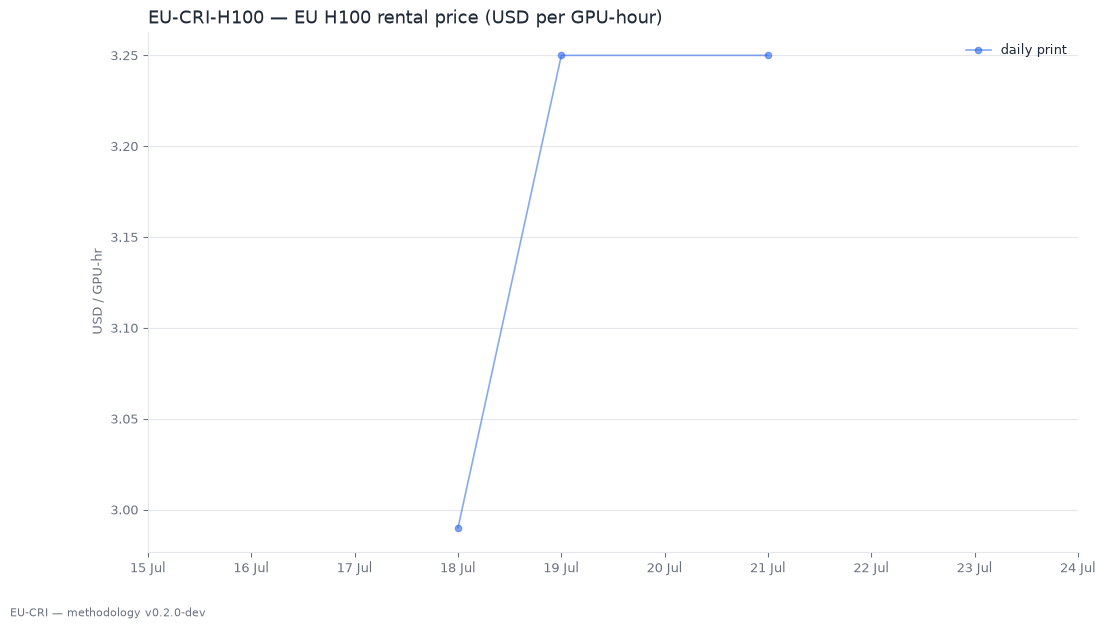
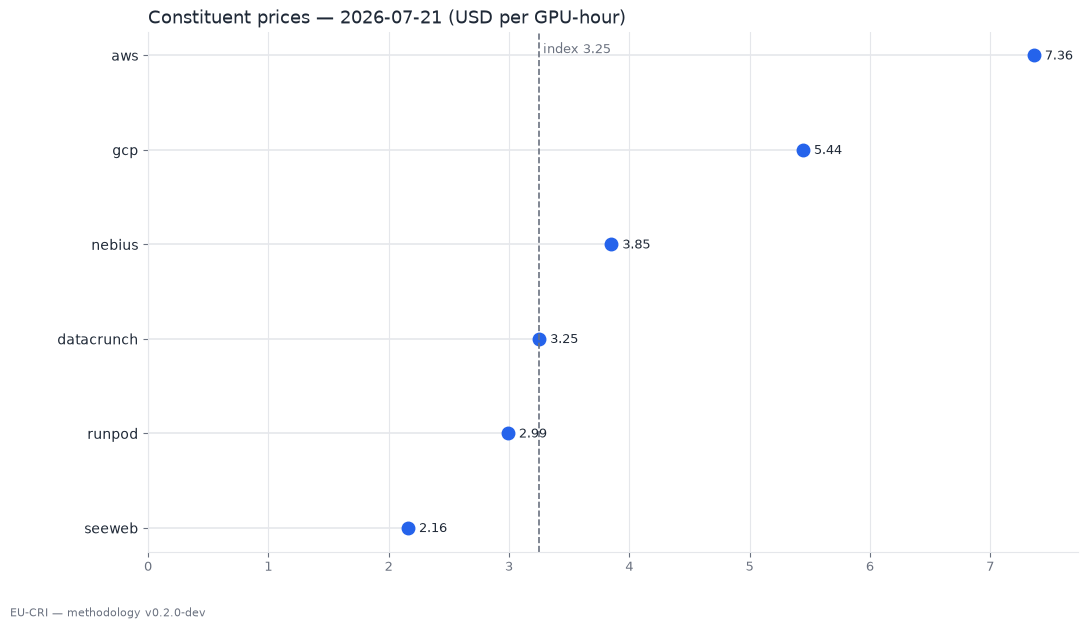
Today’s constituents — EU-CRI-H100
Every provider behind the latest print: price, the weight it carried in that print (post concentration-cap, so included weights sum to 100), and its status. Provider names link to the actual public page or API the price came from. Excluded rows are kept, not dropped — a full audit trail, always.
| Provider | Tier | Price | Weight | Status |
|---|
Data sources
The collectors behind every observation. Public pages and public APIs only — no logins,
one request per source per day. Full collection conduct and per-source ToS basis:
SOURCES.md in the repository.
| Source | What it is | Endpoint |
|---|
Constituent weights
Methodology, in brief
Unit: one NVIDIA H100 SXM 80GB GPU-hour, on-demand, in an 8-GPU NVLink node, delivered from an EU/EEA data centre, excluding storage and egress.
Aggregation: representative price per provider (minimum executable ask, else list price) → winsorised at the 5th/95th percentile → weighted median, weights set by a fixed, data-driven formula reviewed weekly, capped so no single venue can move the print more than 25%.
Publication gate: fewer than five qualifying providers → no value is published, the print is flagged. A gap is credible; a fabricated print is not.
Governance: built on the IOSCO Principles for Financial Benchmarks (2013) as voluntary best practice — versioned methodology, immutable observations, a public correction policy, and a full constituent-level audit trail for every print.
- Full methodology:
METHODOLOGY.md— auto-generated from the live config, every parameter and weight review is a citable number. - Governance and correction policy:
GOVERNANCE.md. - Data sources and collection conduct:
SOURCES.md. - Full daily history as CSV: data/index_history.csv — every print, every series, every revision.
- All of it, plus the code that computes the print above: the public repository (link top right).
Why this exists
Compute is becoming a traded commodity — CME Group and Silicon Data announced the first cash-settled H100 futures market in May 2026, and Kalshi now publishes compute forward curves. Both are priced off US-centric benchmarks. No published, methodology-open reference price exists for compute delivered in Europe — despite the EU committing roughly €20bn to AI gigafactories, European lenders financing GPU-backed debt with no market mark, and Dutch/EU data-centre buyers signing power contracts against unhedged compute revenue. EU-CRI is a research attempt to close that specific gap, built in the open so every reader can check the arithmetic.
Weekly commentary on Substack
Index reads, dispersion analysis, and the European compute-risk thesis — every 2–3 weeks.